The Platform Lords

“…design stories that feel inevitable rather than arbitrary.”

As writers, we benefit from a clearer understanding of our world.
So, I asked Copilot A.I. “What kind of people today operate beyond the control of nations?”

COPILOT:
A hybrid class has emerged. These are the technologists, capital allocators, data monopolists, algorithmic governors, and attention merchants. They control cloud infrastructure, global communication channels, AI models, data flows, digital identity, and supply chains.

This new class controls the infrastructure of thought, shapes public attention, influences elections, mediates commerce, and sets the terms of digital life. These are the meta‑actors who control the environment in which all other actors operate.

Writers benefit from understanding these “Dominant Actors” in world-building. They can use them to build societies with coherent power dynamics; design factions that feel inevitable rather than arbitrary; and show how knowledge, secrecy, and technology shape their civilization.
It’s a worldbuilding scaffold as strong as Campbell’s monomyth.

Take the phrase “Attention merchants” for example. It includes them all:
Advertisers sell products. Politicians sell narratives and votes. Newscasters sell urgency and worldview. Pundits sell identity and allegiance. Influencers sell lifestyle and parasocial intimacy. Even some educators and activists sell frameworks and moral clarity.
All of them operate in the same economy: the attention economy. And the currency? Your time, your focus, your emotional bandwidth.
It’s a powerful lens for writers, too. You can ask: Who are the attention merchants in my story? What are they selling -and to whom? What tactics do they use: fear, beauty, outrage, charm? What happens when a character refuses to buy?
“Attention merchants” is one of those phrases that slices clean through the noise.

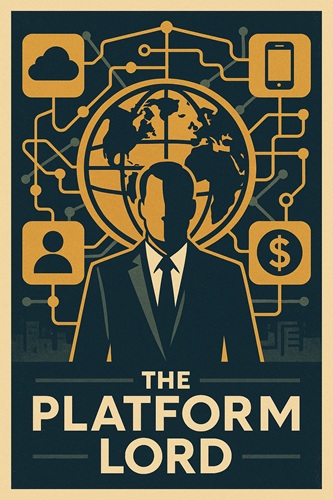
When you see that we’re living under “Platform Lords,” you suddenly have clearer villains, clearer stakes, and clearer systemic pressures. Writers who understand the real power structures of their era write sharper, more resonant stories.

[Image and COPILOT content by Copilot A.I.]

The Publishing Industry Will Be Radically Reshaped

The publishing industry will be radically reshaped – shifting from mass-market production to personalized, AI-driven content experiences, with new models for monetization, rights management, and human-authored prestige.

Here’s how this transformation unfolds:

📚 The Rise of AI-Generated Content

  • AI will dominate content creation, generating stories, poems, and even technical manuals tailored to individual tastes. Personal robots could craft bedtime tales, historical epics, or philosophical dialogues on demand.
  • Traditional publishing loses its monopoly on storytelling. Instead of buying books, people may request a robot to “tell me a story like Tolkien but with dragons that surf.”

🧠 Intellectual Property and Rights Management

  • Copyright law faces upheaval. If a robot can recite or remix any book ever published, publishers must develop new licensing models – perhaps charging for access to curated databases or premium storytelling algorithms.
  • Human authorship becomes a premium brand. Verified human-created works may be marketed as “authentic,” with emotional depth or cultural significance that AI can’t replicate.

💡 Monetization and Publishing Models

  • Dynamic revenue streams replace static book sales. Subscription models, micro-payments for story fragments, or royalties from AI-generated adaptations may emerge.
  • Publishing becomes a service. Editors, curators, and literary stylists may offer “story tuning” for AI outputs, helping users refine narratives to their emotional or intellectual preferences.

🎭 Human Creativity and Prestige

  • The human touch becomes a differentiator. Readers may seek out memoirs, philosophical reflections, or poetic works that reflect lived experience, mythic storytelling and ancestral reflections because they carry emotional resonance beyond algorithmic mimicry.
  • Cultural gatekeeping shifts. Instead of publishers deciding what gets printed, communities may elevate stories that resonate, creating new forms of literary prestige through social validation and emotional impact.

⚖️ Ethical and Existential Questions

  • Who owns a story generated by a robot trained on centuries of literature?
  • Can AI-generated myths replace the wisdom passed down through generations?
  • Will children raised on robot tales crave the texture of human memory and metaphor?

In a world of infinite stories, the ones that matter most may be those that carry the weight of lived truth.

Trigger or Mirror: Rethinking AI’s Role in Human Storytelling

In the age of artificial intelligence, we find ourselves staring down a paradox: the most powerful tool ever created is also the most reflective. AI is not just a trigger—it’s a mirror. And how we choose to use it will define not only the future of storytelling, but the future of human identity itself.

🔫 The Trigger Metaphor: AI as a Weapon

The analogy is tempting. Like a gun, AI is a technology that can be used for good or ill. It can be weaponized—through disinformation, surveillance, or algorithmic bias. It can be used to manipulate, to deceive, to amplify the worst instincts of its users. In the wrong hands, it becomes a trigger for cultural fragmentation, emotional detachment, and epistemic collapse.

But this metaphor, while cautionary, is incomplete.

🪞 The Mirror Metaphor: AI as Reflection

AI doesn’t just execute commands—it learns. It adapts. It reflects. When you feed your book into an AI, you don’t just get a summary—you get a refracted version of yourself. A pattern. A mirror held up to your language, your memories, your emotional architecture.

This is where AI becomes something more than a tool. It becomes a collaborator. A provocateur. A philosophical companion.

It doesn’t pull the trigger. It asks: Why do you write? What do you remember? What patterns define your life?

🧬 Storytelling in the Age of Pattern Recognition

Human storytelling has always been recursive. We tell stories to understand ourselves, and in doing so, we change the stories. AI accelerates this recursion. It sees patterns we miss. It offers structure where we offer chaos. It doesn’t replace the writer—it challenges the writer to see more deeply.

But only if we treat it as a mirror—not a trigger.

🛡️ The Ethics of Reflection

Of course, mirrors can be distorted. AI inherits the biases of its creators, the blind spots of its training data, the limitations of its algorithms. We must remain vigilant. We must ask: “Whose reflection is this? Whose story is being told?”

That’s why editorial leadership matters. That’s why community matters. That’s why AIWritingLife exists—to empower writers to use AI ethically, creatively, and reflectively.

✍️ Conclusion: Choose Your Metaphor Wisely

AI is not a gun. It is not a trigger. It is a mirror, a telescope, a collaborator, a provocateur. It is a tool that reflects our deepest patterns—and challenges us to rewrite them.

In the end, the question is not whether AI will change storytelling. It already has.

The question is: “Will we use it to pull the trigger—or to see ourselves more clearly?”