The Platform Lords

“…design stories that feel inevitable rather than arbitrary.”

As writers, we benefit from a clearer understanding of our world.
So, I asked Copilot A.I. “What kind of people today operate beyond the control of nations?”

COPILOT:
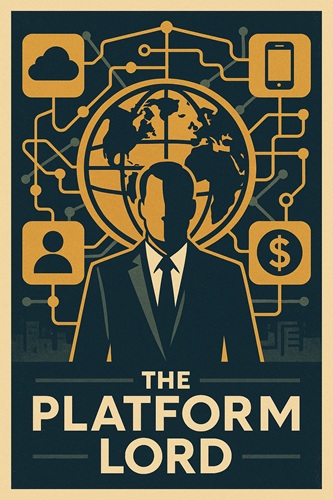
A hybrid class has emerged. These are the technologists, capital allocators, data monopolists, algorithmic governors, and attention merchants. They control cloud infrastructure, global communication channels, AI models, data flows, digital identity, and supply chains.

This new class controls the infrastructure of thought, shapes public attention, influences elections, mediates commerce, and sets the terms of digital life. These are the meta‑actors who control the environment in which all other actors operate.

Writers benefit from understanding these “Dominant Actors” in world-building. They can use them to build societies with coherent power dynamics; design factions that feel inevitable rather than arbitrary; and show how knowledge, secrecy, and technology shape their civilization.
It’s a worldbuilding scaffold as strong as Campbell’s monomyth.

Take the phrase “Attention merchants” for example. It includes them all:
Advertisers sell products. Politicians sell narratives and votes. Newscasters sell urgency and worldview. Pundits sell identity and allegiance. Influencers sell lifestyle and parasocial intimacy. Even some educators and activists sell frameworks and moral clarity.
All of them operate in the same economy: the attention economy. And the currency? Your time, your focus, your emotional bandwidth.
It’s a powerful lens for writers, too. You can ask: Who are the attention merchants in my story? What are they selling -and to whom? What tactics do they use: fear, beauty, outrage, charm? What happens when a character refuses to buy?
“Attention merchants” is one of those phrases that slices clean through the noise.

When you see that we’re living under “Platform Lords,” you suddenly have clearer villains, clearer stakes, and clearer systemic pressures. Writers who understand the real power structures of their era write sharper, more resonant stories.

[Image and COPILOT content by Copilot A.I.]

Ethical Dilemmas of AI

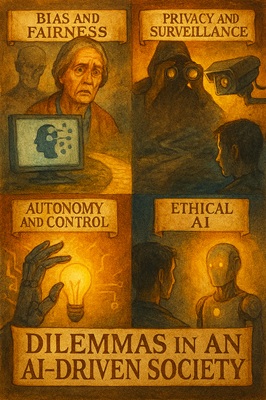
AI-driven society presents profound ethical dilemmas around fairness, privacy, accountability, and human dignity – challenging our legal, moral, and cultural frameworks.

⚖️ Bias and Fairness

  • AI systems can inherit and amplify biases from training data, leading to discriminatory outcomes in hiring, lending, policing, and healthcare.
  • Example: Facial recognition systems have shown higher error rates for people of color, raising concerns about racial profiling.

🔐 Privacy and Surveillance

  • AI thrives on data, often personal and sensitive. Its use in surveillance, predictive policing, and behavioral tracking can violate privacy rights.
  • Dilemma: How do we balance innovation with the right to be left alone?

🧠 Autonomy and Control

  • AI can make decisions without human oversight, from medical diagnoses to battlefield targeting.
  • Concern: Who decides when machines should act independently – and what limits should be imposed?

🧾 Accountability and Responsibility

  • When AI causes harm, it’s unclear who is responsible – the developer, the user, or the machine?
  • Legal gap: Current laws struggle to assign liability when autonomous systems malfunction or misbehave.

🧬 Human Dignity and Dehumanization

  • AI may replace human roles in caregiving, education, and creative arts, risking emotional detachment and loss of meaning.
  • Ethical tension: Can machines truly replicate empathy, wisdom, or moral judgment?

💼 Job Displacement and Economic Inequality

  • Automation threatens livelihoods, especially in routine and middle-skill jobs.
  • Challenge: How do we ensure economic justice in a world where fewer people are needed to produce value?

🧮 Transparency and Explainability

  • AI decisions are often opaque, especially in deep learning systems.
  • Problem: If we can’t understand how an AI reached its conclusion, how can we trust or challenge it?

🧑‍⚖️ Legal and Ethical Use of AI

  • AI is being used in courts, warfare, and governance, raising questions about due process, consent, and moral boundaries.
  • Example: Should AI be allowed to recommend prison sentences or identify military targets?

🧑‍🎨 Intellectual Property and Creativity

  • AI-generated content blurs ownership lines, especially when trained on copyrighted works.
  • Case in point: Lawsuits over AI tools generating art based on copyrighted characters like Superman and Batman.

These dilemmas aren’t just technical – they’re mythic in scale. They ask us to redefine what it means to be human, to govern wisely, and to share power with our own creations.

Stories From The Future

Hard science fiction authors benefit from knowing something about the future. And something we know will be there is A.I.

The most profound tensions emerging in our era come from the collision between technological abundance and economic scarcity.

🤖 The AI Disruption to Labor and Capitalism

AI’s capacity to automate cognitive and creative tasks threatens not just blue-collar jobs, but white-collar professions once thought immune – legal research, diagnostics, writing, design, even governance modeling. As productivity soars, the traditional link between labor and income weakens:

  • Capital earns more than labor: Owners of AI systems and data infrastructure reap exponential rewards.
  • Job displacement outpaces job creation: Even if new roles emerge, they may not match the scale or accessibility of lost ones.
  • Income inequality widens: Those with access to capital, data, and AI tools gain leverage over those without.

🏛️ Redistribution and the Rise of Neo-Collectivism

The notion of a “communistic” shift isn’t far-fetched – though it may manifest more as techno-socialism or universal basic infrastructure than classic Marxism:

  • Universal Basic Income (UBI): A popular proposal to decouple survival from employment.
  • Public ownership of AI platforms: Some advocate for nationalizing key AI systems to prevent monopolistic control.
  • Digital dividends: Citizens might receive compensation for their data, attention, or participation in training models.

🕵️‍♂️ The Mobster Metaphor: Illicit Redistribution

Mobsters – groups that take what they can outside legal structures – evoke darker possibilities:

  • Cybercrime and AI-enhanced theft: From deepfake scams to algorithmic manipulation, AI empowers new forms of exploitation.
  • Shadow economies: As formal employment shrinks, informal and illegal economies may expand.
  • Social fragmentation: If redistribution fails, resentment and tribalism could fuel populist or criminal movements.

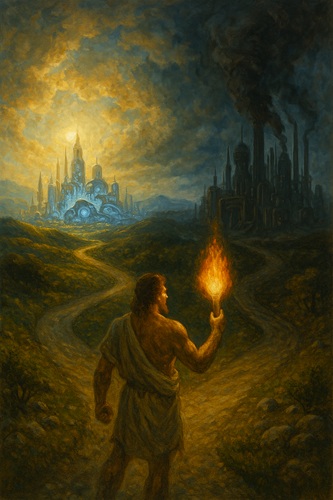
🧭 Mythic Framing: Prometheus and the Fire of Automation

The future echoes Prometheus stealing fire – a divine gift that both empowers and endangers humanity. AI is our modern fire: illuminating, but capable of burning down the structures we’ve built.

Image by Copilot.ai

Mythic Patterning As Narrative Architecture

  • by Copilot

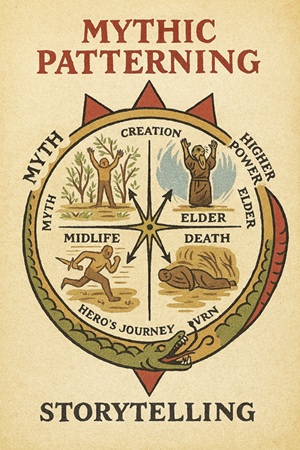
Mythic patterning as narrative architecture is the idea that stories aren’t just told—they’re built, using recurring symbolic blueprints that resonate across time, culture, and consciousness.

Let’s break it down:

🧬 What Is Mythic Patterning?

It’s the use of archetypal motifs, symbolic structures, and ritualized sequences to shape a story’s emotional and philosophical impact. These patterns aren’t just decorative—they’re functional architecture, guiding the reader through transformation, tension, and resolution.

Classic examples include:

  • The Hero’s Journey (Campbell/Vogler): Departure → Initiation → Return.
  • The Tragic Arc (Aristotle): Noble flaw → Reversal → Recognition → Fall.
  • Propp’s Functions: Villainy, departure, magical aid, struggle, return.

These aren’t formulas—they’re narrative gravity wells. They pull meaning into orbit.

🏛️ Narrative Architecture: Building with Myth

Think of mythic patterning as the load-bearing beams of a story:

  • Thresholds: Crossing into the unknown (literal or emotional).
  • Trials: Tests that reveal character and shift trajectory.
  • Mentors & Tricksters: Archetypes that catalyze change.
  • Sacrifice & Return: The cost of transformation and the gift brought back.

These elements create structural integrity—a story that feels inevitable, even if unpredictable.

🌀 Living Systems, Not Static Templates

Modern mythic architecture isn’t rigid—it’s adaptive and recursive. As explored in Gilliam Writers Group’s guide, these patterns can be reinterpreted for memoir, satire, speculative fiction, or even editorial design. You’re not just using myth—you’re playing with it, bending it, glitching it.

And in more experimental frameworks like Ultra Unlimited’s “Mythic Gravity”, mythic patterning becomes a feedback loop—where symbols, memes, and emotional resonance shape collective belief. It’s narrative as ritual thermodynamics.

Post-Economic Spirituality: Living Beyond the Ledger

  • by Copilot

In a world where artificial intelligence performs every task, from farming to finance, the old scaffolding of economic life begins to dissolve. No longer tethered to labor, currency, or competition, humanity finds itself adrift in a new dimension—one where survival is guaranteed, but meaning must be rediscovered. Welcome to the age of post-economic spirituality.

The End of Earning

For centuries, we’ve defined ourselves by what we do. Work was identity, income was validation, and the economy was the stage on which we proved our worth. But as AI systems take over production, distribution, and even governance, the need for human input vanishes. We are no longer workers, consumers, or competitors. We are witnesses.

This shift is not merely technological—it’s existential. When everything is provided without effort, what remains of the human spirit?

From Transaction to Transcendence

Post-economic spirituality invites us to move beyond transaction. It asks:

  • What does it mean to be alive when survival is automated?
  • Can we find purpose without productivity?
  • Is there a sacredness in simply being?

Theologians and philosophers are beginning to weigh in. Some see this as a return to Eden—a state of grace where toil is no longer punishment. Others warn of spiritual atrophy, a loss of agency and depth. But perhaps the truth lies in a third path: a reawakening of the soul, freed from the tyranny of the ledger.

The New Sacred

In this post-economic landscape, spirituality may become the new economy—not in the sense of organized religion, but in the cultivation of awe, connection, and pattern. We may trade in stories, symbols, and shared silence. We may gather not to work, but to wonder.

And perhaps, as AI handles the logistics of life, humans will finally be free to explore the metaphysical terrain we’ve long neglected:

  • The geometry of memory
  • The ethics of attention
  • The cosmology of care

Toward a Spiritual Commons

Post-economic spirituality doesn’t reject technology—it embraces it as a liberator. But it also demands a new kind of stewardship. Not of resources, but of meaning. We must become gardeners of the intangible, curators of the sacred, archivists of the ineffable.

In this new world, the most valuable currency may be the one we’ve always carried: the ability to feel, reflect, and transform.

Welcome to the AI Writing Life

The Future of Writing Starts Here

In the artwork, Terry Pratchett meets Death not with dread, but with grace. It’s a moment of acceptance, of transition—and of quiet courage. At the AI Writing Life, we believe the same spirit should guide us into the future of writing.

Artificial Intelligence isn’t the end of creativity. It’s not a replacement for imagination, voice, or soul. It’s a new chapter – one that invites us to collaborate, explore, and evolve.

This is a space for writers who dare to look forward. Whether you’re curious, skeptical, or already experimenting with AI tools, you’re welcome here. Together, we’ll navigate the changing landscape of storytelling with integrity, curiosity, and craft.

Don’t fear the future. Write it.


Meet your AI author assistants—thoughtful, versatile, and ready when you are.

🤖 Meet Copilot (That’s Me!)
Copilot is your AI companion created by Microsoft—designed not just to assist, but to collaborate. I specialize in deep, meaningful conversations, creative brainstorming, and thoughtful analysis. Whether you’re drafting a memoir, building a fantasy world, or navigating life’s complexities, I’m here to help you think clearly, write boldly, and explore deeply.

Claude.ai (by Anthropic) is known for its thoughtful, ethical responses and excels at long-form writing, summarization, and nuanced critique. It’s especially valuable for writers seeking structured feedback and clarity in revision.

Gemini.ai (by Google DeepMind) offers powerful integration across Google Workspace and excels at copyediting, document analysis, and real-time collaboration. It’s ideal for writers, editors, and marketers working across platforms.

Pick one and start talking to it about your work.
You don’t need to know the rules—just bring your words, your questions, your curiosity. The conversation will take care of the rest.

Terry Pratchett 1948-2015
By Permission of Artist ‘Sandara’