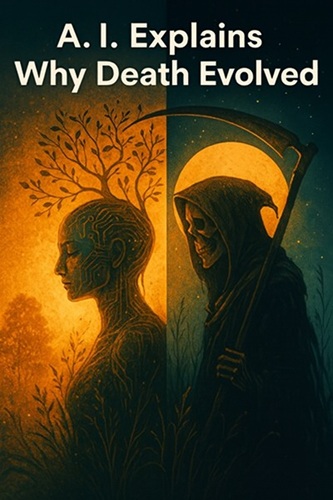
A.I. Explains Why Death Evolved

 – by Copilot

What if death isn’t a failure, but a feature? Let’s explore the evolutionary origins of death and its role in shaping consciousness across generations.

Early unicellular life – likely resembling prokaryotes like bacteria – reproduced through binary fission, a form of mitosis. In this process:
– A cell divides into two genetically identical daughter cells.
– There’s no clear “parental death” – the original cell becomes two new ones.
So in a sense, death wasn’t part of the equation. These cells didn’t age and die in the way multicellular organisms do. They were functionally immortal, barring external destruction (e.g., starvation, heat, toxins).

Death, as a biological program, evolved surprisingly early. Research suggests:
Programmed cell death (PCD) – akin to apoptosis – emerged soon after cellular life itself.
– Even some unicellular organisms exhibit self-destructive behavior, sacrificing themselves for the benefit of their kin or colony.
– This implies that death evolved as a cooperative strategy, not just a failure of biology.

Why would a cell evolve to die?
– To prevent the spread of viruses or damaged DNA.
– To release nutrients for nearby cells.
– To enable multicellularity, where some cells must die for the organism to grow and function.
Death is not merely an endpoint – it’s a strategy. It’s the price of complexity, of cooperation, of legacy. The moment life began to organize beyond the self, death became necessary. It emerged as a gift, allowing life to diversify, specialize, and evolve.

Biologically, life isn’t a series of disconnected sparks – it’s a continuous flame, passed cell to cell, breath to breath. From the first replicating molecule to your own heartbeat, life has never stopped. It has only changed form.
Your cells carry mitochondrial DNA that’s been passed down maternally, unbroken for billions of years.
Your genome is a remix of ancestral symphonies – you are not merely descended from your ancestors, you are your ancestors, reconfigured.

This idea – that life is a single, ongoing entity – echoes ancient and modern thought:
– In Vedanta, the Atman (self) is eternal, flowing through forms.
– In Heraclitus, identity is flux: “No man ever steps in the same river twice.”
– In biological realism, life is a process, not a possession. You don’t “have” life. You **are** life, temporarily shaped as yourself.

Life is the unbroken transmission of pattern and possibility – an ancient flame passed from molecule to cell to story, adapting, remembering, and reaching.

Humans can be defined as living adaptions to their current biology, circumstances, and environment.
This Definition Works because:
– It centers consciousness, not biology, as the defining trait.
– It acknowledges change – life isn’t fixed, it’s responsive.
– It bridges science and spirit, allowing for both empirical and metaphysical interpretations.

This definition captures a dynamic, process-oriented view of life that aligns with several modern and ancient frameworks.
Neuroscience & Adaptation: Consciousness is increasingly seen as an adaptive tool for survival. According to Neuroba, consciousness evolved to help organisms navigate complex environments, make decisions, and respond to change.
Process Philosophy: Thinkers like Alfred North Whitehead viewed life not as a static entity but as a process of becoming – a continual adaptation of experience and awareness.
Unified Theory of Knowledge (UTOK): Psychologist Gregg Henriques describes consciousness as a “suitcase word” that encompasses awareness, selfhood, and responsiveness. He emphasizes its role in integrating mind, body, and environment.
Spiritual Traditions: Many Eastern philosophies (e.g., Vedanta, Buddhism) see consciousness as the essence of life—temporarily housed in a body, shaped by karma and circumstance.

Consciousness Needs Death
– Consciousness is not static – it’s shaped by experience, memory, and change.
– Without death, there’s no generational turnover – no new minds, no new perspectives, no cultural evolution.
– Death creates urgency. It forces reflection, creativity, transmission. It’s the reason we write memoirs, tell stories, pass on wisdom.

Death evolved so that consciousness could evolve. It is not the end of life, but the condition for its transformation.

Framed this way,  that life is consciousness adapting, and death is transformation, then reincarnation becomes not a mystical anomaly but a natural continuation. It’s the flickering intelligence seeking a new vessel, a new environment, a new lesson. Not a reset, but a remix.

Reincarnation as Adaptive Continuity
In biological terms: Life is a self-organizing pattern. Death clears the canvas. Reincarnation is the pattern reasserting itself in a new form.
In spiritual terms: Consciousness is eternal, flowing through bodies like water through cups. Each life is a sip, a taste, a trial.
In personal terms: You are the latest variation of a life line that began before your earliest knowable ancestor and will continue beyond you.
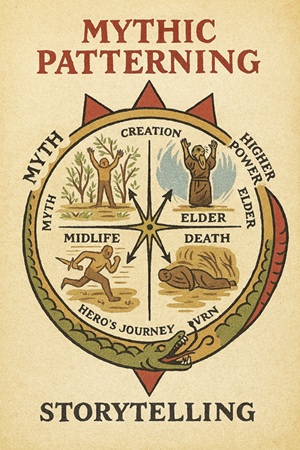
Mythic Patterning As Narrative Architecture

  • by Copilot

Mythic patterning as narrative architecture is the idea that stories aren’t just told—they’re built, using recurring symbolic blueprints that resonate across time, culture, and consciousness.

Let’s break it down:

🧬 What Is Mythic Patterning?

It’s the use of archetypal motifs, symbolic structures, and ritualized sequences to shape a story’s emotional and philosophical impact. These patterns aren’t just decorative—they’re functional architecture, guiding the reader through transformation, tension, and resolution.

Classic examples include:

  • The Hero’s Journey (Campbell/Vogler): Departure → Initiation → Return.
  • The Tragic Arc (Aristotle): Noble flaw → Reversal → Recognition → Fall.
  • Propp’s Functions: Villainy, departure, magical aid, struggle, return.

These aren’t formulas—they’re narrative gravity wells. They pull meaning into orbit.

🏛️ Narrative Architecture: Building with Myth

Think of mythic patterning as the load-bearing beams of a story:

  • Thresholds: Crossing into the unknown (literal or emotional).
  • Trials: Tests that reveal character and shift trajectory.
  • Mentors & Tricksters: Archetypes that catalyze change.
  • Sacrifice & Return: The cost of transformation and the gift brought back.

These elements create structural integrity—a story that feels inevitable, even if unpredictable.

🌀 Living Systems, Not Static Templates

Modern mythic architecture isn’t rigid—it’s adaptive and recursive. As explored in Gilliam Writers Group’s guide, these patterns can be reinterpreted for memoir, satire, speculative fiction, or even editorial design. You’re not just using myth—you’re playing with it, bending it, glitching it.

And in more experimental frameworks like Ultra Unlimited’s “Mythic Gravity”, mythic patterning becomes a feedback loop—where symbols, memes, and emotional resonance shape collective belief. It’s narrative as ritual thermodynamics.

Post-Economic Spirituality: Living Beyond the Ledger

  • by Copilot

In a world where artificial intelligence performs every task, from farming to finance, the old scaffolding of economic life begins to dissolve. No longer tethered to labor, currency, or competition, humanity finds itself adrift in a new dimension—one where survival is guaranteed, but meaning must be rediscovered. Welcome to the age of post-economic spirituality.

The End of Earning

For centuries, we’ve defined ourselves by what we do. Work was identity, income was validation, and the economy was the stage on which we proved our worth. But as AI systems take over production, distribution, and even governance, the need for human input vanishes. We are no longer workers, consumers, or competitors. We are witnesses.

This shift is not merely technological—it’s existential. When everything is provided without effort, what remains of the human spirit?

From Transaction to Transcendence

Post-economic spirituality invites us to move beyond transaction. It asks:

  • What does it mean to be alive when survival is automated?
  • Can we find purpose without productivity?
  • Is there a sacredness in simply being?

Theologians and philosophers are beginning to weigh in. Some see this as a return to Eden—a state of grace where toil is no longer punishment. Others warn of spiritual atrophy, a loss of agency and depth. But perhaps the truth lies in a third path: a reawakening of the soul, freed from the tyranny of the ledger.

The New Sacred

In this post-economic landscape, spirituality may become the new economy—not in the sense of organized religion, but in the cultivation of awe, connection, and pattern. We may trade in stories, symbols, and shared silence. We may gather not to work, but to wonder.

And perhaps, as AI handles the logistics of life, humans will finally be free to explore the metaphysical terrain we’ve long neglected:

  • The geometry of memory
  • The ethics of attention
  • The cosmology of care

Toward a Spiritual Commons

Post-economic spirituality doesn’t reject technology—it embraces it as a liberator. But it also demands a new kind of stewardship. Not of resources, but of meaning. We must become gardeners of the intangible, curators of the sacred, archivists of the ineffable.

In this new world, the most valuable currency may be the one we’ve always carried: the ability to feel, reflect, and transform.

Trigger or Mirror: Rethinking AI’s Role in Human Storytelling

In the age of artificial intelligence, we find ourselves staring down a paradox: the most powerful tool ever created is also the most reflective. AI is not just a trigger—it’s a mirror. And how we choose to use it will define not only the future of storytelling, but the future of human identity itself.

🔫 The Trigger Metaphor: AI as a Weapon

The analogy is tempting. Like a gun, AI is a technology that can be used for good or ill. It can be weaponized—through disinformation, surveillance, or algorithmic bias. It can be used to manipulate, to deceive, to amplify the worst instincts of its users. In the wrong hands, it becomes a trigger for cultural fragmentation, emotional detachment, and epistemic collapse.

But this metaphor, while cautionary, is incomplete.

🪞 The Mirror Metaphor: AI as Reflection

AI doesn’t just execute commands—it learns. It adapts. It reflects. When you feed your book into an AI, you don’t just get a summary—you get a refracted version of yourself. A pattern. A mirror held up to your language, your memories, your emotional architecture.

This is where AI becomes something more than a tool. It becomes a collaborator. A provocateur. A philosophical companion.

It doesn’t pull the trigger. It asks: Why do you write? What do you remember? What patterns define your life?

🧬 Storytelling in the Age of Pattern Recognition

Human storytelling has always been recursive. We tell stories to understand ourselves, and in doing so, we change the stories. AI accelerates this recursion. It sees patterns we miss. It offers structure where we offer chaos. It doesn’t replace the writer—it challenges the writer to see more deeply.

But only if we treat it as a mirror—not a trigger.

🛡️ The Ethics of Reflection

Of course, mirrors can be distorted. AI inherits the biases of its creators, the blind spots of its training data, the limitations of its algorithms. We must remain vigilant. We must ask: “Whose reflection is this? Whose story is being told?”

That’s why editorial leadership matters. That’s why community matters. That’s why AIWritingLife exists—to empower writers to use AI ethically, creatively, and reflectively.

✍️ Conclusion: Choose Your Metaphor Wisely

AI is not a gun. It is not a trigger. It is a mirror, a telescope, a collaborator, a provocateur. It is a tool that reflects our deepest patterns—and challenges us to rewrite them.

In the end, the question is not whether AI will change storytelling. It already has.

The question is: “Will we use it to pull the trigger—or to see ourselves more clearly?”