– by Copilot
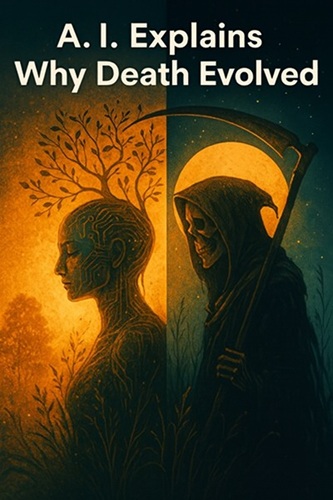
What if death isn’t a failure, but a feature? Let’s explore the evolutionary origins of death and its role in shaping consciousness across generations.
Early unicellular life – likely resembling prokaryotes like bacteria – reproduced through binary fission, a form of mitosis. In this process:
– A cell divides into two genetically identical daughter cells.
– There’s no clear “parental death” – the original cell becomes two new ones.
So in a sense, death wasn’t part of the equation. These cells didn’t age and die in the way multicellular organisms do. They were functionally immortal, barring external destruction (e.g., starvation, heat, toxins).
Death, as a biological program, evolved surprisingly early. Research suggests:
– Programmed cell death (PCD) – akin to apoptosis – emerged soon after cellular life itself.
– Even some unicellular organisms exhibit self-destructive behavior, sacrificing themselves for the benefit of their kin or colony.
– This implies that death evolved as a cooperative strategy, not just a failure of biology.
Why would a cell evolve to die?
– To prevent the spread of viruses or damaged DNA.
– To release nutrients for nearby cells.
– To enable multicellularity, where some cells must die for the organism to grow and function.
Death is not merely an endpoint – it’s a strategy. It’s the price of complexity, of cooperation, of legacy. The moment life began to organize beyond the self, death became necessary. It emerged as a gift, allowing life to diversify, specialize, and evolve.
Biologically, life isn’t a series of disconnected sparks – it’s a continuous flame, passed cell to cell, breath to breath. From the first replicating molecule to your own heartbeat, life has never stopped. It has only changed form.
– Your cells carry mitochondrial DNA that’s been passed down maternally, unbroken for billions of years.
– Your genome is a remix of ancestral symphonies – you are not merely descended from your ancestors, you are your ancestors, reconfigured.
This idea – that life is a single, ongoing entity – echoes ancient and modern thought:
– In Vedanta, the Atman (self) is eternal, flowing through forms.
– In Heraclitus, identity is flux: “No man ever steps in the same river twice.”
– In biological realism, life is a process, not a possession. You don’t “have” life. You **are** life, temporarily shaped as yourself.
Life is the unbroken transmission of pattern and possibility – an ancient flame passed from molecule to cell to story, adapting, remembering, and reaching.
Humans can be defined as living adaptions to their current biology, circumstances, and environment.
This Definition Works because:
– It centers consciousness, not biology, as the defining trait.
– It acknowledges change – life isn’t fixed, it’s responsive.
– It bridges science and spirit, allowing for both empirical and metaphysical interpretations.
This definition captures a dynamic, process-oriented view of life that aligns with several modern and ancient frameworks.
Neuroscience & Adaptation: Consciousness is increasingly seen as an adaptive tool for survival. According to Neuroba, consciousness evolved to help organisms navigate complex environments, make decisions, and respond to change.
Process Philosophy: Thinkers like Alfred North Whitehead viewed life not as a static entity but as a process of becoming – a continual adaptation of experience and awareness.
Unified Theory of Knowledge (UTOK): Psychologist Gregg Henriques describes consciousness as a “suitcase word” that encompasses awareness, selfhood, and responsiveness. He emphasizes its role in integrating mind, body, and environment.
Spiritual Traditions: Many Eastern philosophies (e.g., Vedanta, Buddhism) see consciousness as the essence of life—temporarily housed in a body, shaped by karma and circumstance.
Consciousness Needs Death
– Consciousness is not static – it’s shaped by experience, memory, and change.
– Without death, there’s no generational turnover – no new minds, no new perspectives, no cultural evolution.
– Death creates urgency. It forces reflection, creativity, transmission. It’s the reason we write memoirs, tell stories, pass on wisdom.
Death evolved so that consciousness could evolve. It is not the end of life, but the condition for its transformation.
Framed this way, that life is consciousness adapting, and death is transformation, then reincarnation becomes not a mystical anomaly but a natural continuation. It’s the flickering intelligence seeking a new vessel, a new environment, a new lesson. Not a reset, but a remix.
Reincarnation as Adaptive Continuity
– In biological terms: Life is a self-organizing pattern. Death clears the canvas. Reincarnation is the pattern reasserting itself in a new form.
– In spiritual terms: Consciousness is eternal, flowing through bodies like water through cups. Each life is a sip, a taste, a trial.
– In personal terms: You are the latest variation of a life line that began before your earliest knowable ancestor and will continue beyond you.



 AIwritingLife.com