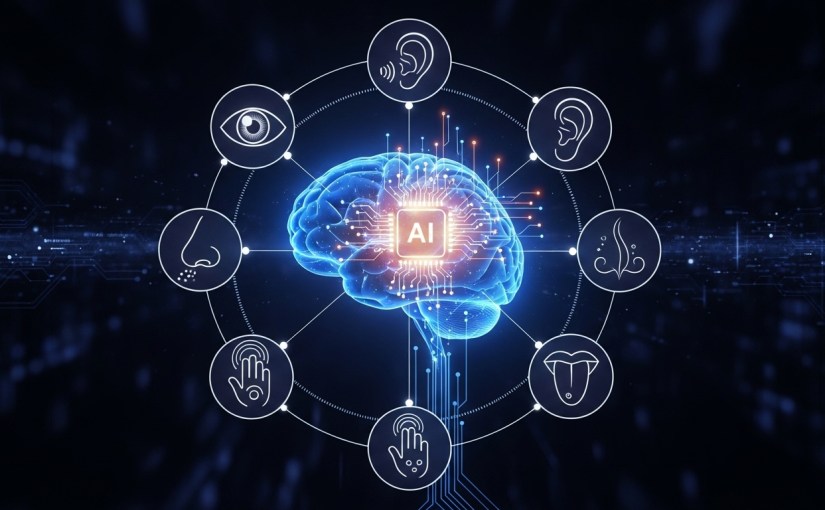
COPILOT: How does AI reorganize the balance of human perception, attention, and cognition the way print, radio, and television once did?
When a medium reorganizes the sensory ratio, we’re no longer talking about a small cultural shift; we’re talking about a civilizational hinge. Here’s the clearest way to understand it.
🎛️ What Marshall McLuhan Meant by “Sensory Ratio”
McLuhan argued that every medium rebalances the senses — not by changing our biology, but by changing:
- what we pay attention to
- what we ignore
- what we externalize
- what we internalize
- what we consider “real”
Print amplified the visual.
Radio amplified the auditory.
Television amplified the tactile/participatory field.
Each medium reorganized the ratio of sensory and cognitive emphasis.
AI is the first medium that reorganizes all of them at once.
🔮 1. AI collapses the sensory hierarchy
Before AI, each medium privileged one sense:
- Print → visual
- Radio → auditory
- Film → visual + auditory
- Television → tactile field (in McLuhan’s sense of “involving”)
AI is polymodal. It can generate, remix, or interpret:
- text
- images
- sound
- video
- gesture
- spatial environments
- emotional tone
- symbolic structure
This means AI doesn’t amplify one sense — it equalizes them.
The sensory ratio becomes fluid, dynamic, and user‑directed.
🧠 2. AI shifts us from perceiving to selecting
In earlier media environments, the senses were engaged directly:
- You read text
- You watched TV
- You listened to radio
AI changes the role of the senses:
We no longer primarily perceive media — we choose what the AI will generate for us to perceive.
This shifts the sensory ratio from input‑driven to intention‑driven.
The dominant “sense” becomes executive function — the ability to specify, prompt, refine, and evaluate.
That’s a profound shift.
🌀 3. AI creates synthetic sensory experiences
AI can now:
- generate images you’ve never seen
- simulate voices you’ve never heard
- create scenes that never existed
- produce sensory combinations no medium ever allowed
This introduces a new sensory category:
Synthetic perception — experiences not derived from the world but from computation.
This alters the sensory ratio by adding a fourth sensory domain:
- Visual
- Auditory
- Tactile
- Synthetic (AI‑generated multimodal experience)
This is the first new sensory category since the invention of symbolic language.
🧩 4. AI reduces the cost of switching between sensory modes
Before AI, switching modes was expensive:
- Reading → watching → listening → interacting
- Each required a different medium, device, or context
AI collapses these boundaries:
- A prompt becomes an image
- An image becomes a video
- A video becomes a script
- A script becomes a voice
- A voice becomes an interactive agent
The sensory ratio becomes liquid — constantly reconfigurable.
This is unprecedented.
🔍 5. AI amplifies pattern‑recognition over raw sensation
AI environments reward:
- abstraction
- synthesis
- meta‑perception
- conceptual navigation
In other words, the “dominant sense” becomes pattern‑sense — the ability to see structure across modalities.
AI shifts the sensory ratio toward:
- systems
- models
- abstractions
- relationships
- meta‑structures
🧭 6. AI externalizes perception itself
This is the deepest shift.
AI can now:
- see for us
- hear for us
- summarize for us
- interpret for us
- filter for us
- decide what matters
This means the sensory ratio is no longer just about our senses — it’s about the division of labor between human perception and machine perception.
The new ratio is:
- What we perceive
- What the machine perceives
- How we integrate the two
This is a new kind of sensory ecology.
🧨 The punchline
AI reshapes the sensory ratio by:
- equalizing the senses
- adding synthetic perception
- shifting from input to intention
- amplifying abstraction over sensation
- externalizing perception itself
It’s not just a new medium — it’s a new sensory architecture.
 AIwritingLife.com