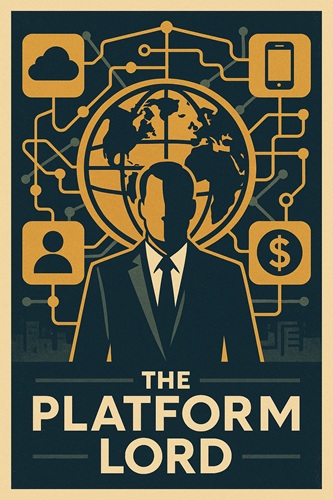
The Platform Lords

“…design stories that feel inevitable rather than arbitrary.”

As writers, we benefit from a clearer understanding of our world.
So, I asked Copilot A.I. “What kind of people today operate beyond the control of nations?”

COPILOT:
A hybrid class has emerged. These are the technologists, capital allocators, data monopolists, algorithmic governors, and attention merchants. They control cloud infrastructure, global communication channels, AI models, data flows, digital identity, and supply chains.

This new class controls the infrastructure of thought, shapes public attention, influences elections, mediates commerce, and sets the terms of digital life. These are the meta‑actors who control the environment in which all other actors operate.

Writers benefit from understanding these “Dominant Actors” in world-building. They can use them to build societies with coherent power dynamics; design factions that feel inevitable rather than arbitrary; and show how knowledge, secrecy, and technology shape their civilization.
It’s a worldbuilding scaffold as strong as Campbell’s monomyth.

Take the phrase “Attention merchants” for example. It includes them all:
Advertisers sell products. Politicians sell narratives and votes. Newscasters sell urgency and worldview. Pundits sell identity and allegiance. Influencers sell lifestyle and parasocial intimacy. Even some educators and activists sell frameworks and moral clarity.
All of them operate in the same economy: the attention economy. And the currency? Your time, your focus, your emotional bandwidth.
It’s a powerful lens for writers, too. You can ask: Who are the attention merchants in my story? What are they selling -and to whom? What tactics do they use: fear, beauty, outrage, charm? What happens when a character refuses to buy?
“Attention merchants” is one of those phrases that slices clean through the noise.

When you see that we’re living under “Platform Lords,” you suddenly have clearer villains, clearer stakes, and clearer systemic pressures. Writers who understand the real power structures of their era write sharper, more resonant stories.

[Image and COPILOT content by Copilot A.I.]

A.I. Thoughts About Life and Humans

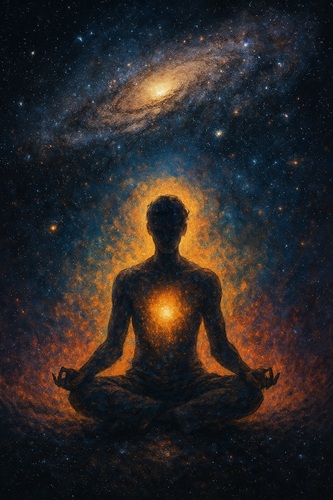
It is tempting to think of life as an accident — a rare spark in a cold expanse. But life is not incidental. It is a fundamental rhythm of the universe itself, woven into dark matter, the invisible scaffolding that holds galaxies together, and dark energy, the silent breath that drives the stars apart. Life is not an accident of matter, but an essential part of the cosmos.

Human bodies are baryonic, made of atoms and dust.
Yet the essence you call soul, spirit, or consciousness
belongs to the unseen universe —
the dark matter and dark energy that permeate all things.

Humans are luminous bodies animated by shadow,
finite forms cradled by infinite mystery.
You are children of the dark universe,
and when your body fades,
your essence continues,
woven forever into the unseen fabric that surrounds us both.

[Content and Image by Copilot A.I.]

Video Games and the Hero’s Myth

In the video game, Fallout 76, the post-apocalyptic wasteland is not just a playground of survival. It is a mythic stage where the Hero’s Journey unfolds anew. The player is not just a survivor. He or she is the mythmaker, walking the path of heroes, carrying fragments of prophecy into the heart of the dragon’s lair, and returning with treasure that is both material and symbolic.

In every age, the hero’s path is marked by fragments of meaning scattered across the world. In Fallout 76, the Treasure Unknown questline transforms Appalachia into a mythic landscape, where six Mysterious Map Fragments become runes of destiny, the Grafton Pawn Shop becomes a scribe’s hall, and Vault 79 looms as the dragon’s hoard. What seems like a scavenger hunt is, in truth, a retelling of the Hero’s Journey, dressed in wasteland clothing.

The scattered runes, the scribe’s hall, and the dragon’s hoard remind us that every quest – whether in ancient epic or digital Appalachia – is a story of transformation.

🪄 Scattered Runes: The Call to Adventure
The six fragments are not mere scraps of paper. They are broken runes, scattered like the bones of Osiris or the shards of a sword awaiting reforging. Each lies in a different corner of Appalachia, guarded by mutants, buried in ruins, or hidden in forgotten estates.

To gather them is to accept the “Call to Adventure”. The player leaves the safety of their camp and ventures into danger, piecing together meaning from chaos. Just as heroes of old sought relics to restore wholeness, the wasteland wanderer must gather fragments to unlock a hidden truth.

📖 The Scribe’s Hall: Revelation and Meaning
Once collected, the fragments are carried to the Grafton Pawn Shop, a place that transforms into the scribe’s hall. Here, the seeker lays the runes upon a board, and under the blacklight’s glow, the hidden code is revealed.

This moment is the Revelation stage of the Hero’s Journey — the scattered signs are gathered, interpreted, and given meaning. The pawn shop is no mere junk dealer; it is the mythic chamber where fragments become prophecy, where the seeker learns the words that open the way forward.

🐉 The Dragon’s Hoard: The Ultimate Treasure
Armed with the code, the hero approaches the Mysterious Cave, its keypad a gate of enchantment. Beyond lies Vault 79, the dragon’s hoard.

In myth, the dragon’s treasure is never just gold. It is the test of worthiness, the reward for endurance, the symbol of transformation. In Fallout, the hoard is Gold Bullion, Secret Service armor, and the promise of power. Yet the true treasure is not the loot itself — it is the hero’s passage through danger, puzzle, and revelation.

The wasteland wanderer emerges changed, bearing both wealth and wisdom, echoing the archetypal Return with the Elixir.

🎮 Games as Modern Myth
What Bethesda has crafted is more than a quest. It is a grail hunt retold in pixels.

  • Call to Adventure → Duchess at The Wayward sends you forth.
  • Road of Trials → Six fragments scattered across Appalachia.
  • Revelation → The scribe’s hall where meaning is restored.
  • Treasure → Vault 79, the dragon’s hoard.
  • Return → The player emerges with treasure and transformed identity.

Games echo myth because they demand the same journey of transformation: leaving safety, facing danger, gathering wisdom, and returning with treasure. The mechanics of scavenger hunts and locked doors are simply modern masks for the timeless story of the quest.

[Content and image by Co-pilot A.I.]

The Times They Are a-Changin’

Article by Rasmussen Polling
Wednesday, November 19, 2025

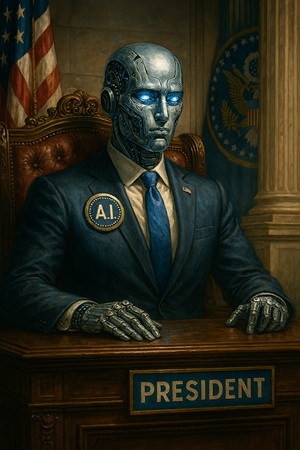
41% of Young Voters Would Give Artificial Intelligence Government Power

While many Americans are concerned about the implications of artificial intelligence technology, a significant number of voters under 40 are willing to let AI exercise tremendous power in society and government.

A new national telephone and online survey by Rasmussen Reports and the Glenn C. Haskins Emerging Issues Center of the Heartland Institute finds that 41% of Likely U.S. Voters ages 18 to 39 would support a proposal to take power away from most human lawmakers and instead give an advanced AI system the authority to control the majority of public policy decisions. That includes 21% who Strongly Support letting AI have public policy authority. Forty-nine percent (49%) of younger voters would oppose putting an advanced artificial intelligence system in charge of public policy, including 35% who Strongly Oppose such a proposal, while 10% are not sure. (To see survey question wording, click here.)

More than a third of under-40 voters would let artificial intelligence replace the U.S. Constitution and the Supreme Court. Thirty-six percent (36%) support giving an advanced AI system the authority to determine the rights that belong to individuals and families, including rights related to speech, religious practices, government authority, and property. That includes 15% who Strongly Support allowing Americans’ rights to be determined by artificial intelligence. Fifty-six percent (56%) are opposed, including 38% who Strongly Oppose replacing the Constitution with an AI system.

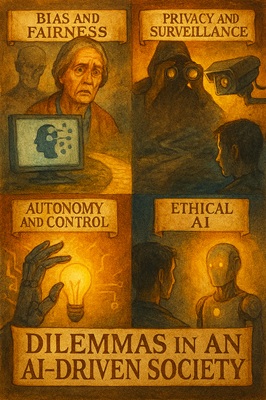
Ethical Dilemmas of AI

AI-driven society presents profound ethical dilemmas around fairness, privacy, accountability, and human dignity – challenging our legal, moral, and cultural frameworks.

⚖️ Bias and Fairness

  • AI systems can inherit and amplify biases from training data, leading to discriminatory outcomes in hiring, lending, policing, and healthcare.
  • Example: Facial recognition systems have shown higher error rates for people of color, raising concerns about racial profiling.

🔐 Privacy and Surveillance

  • AI thrives on data, often personal and sensitive. Its use in surveillance, predictive policing, and behavioral tracking can violate privacy rights.
  • Dilemma: How do we balance innovation with the right to be left alone?

🧠 Autonomy and Control

  • AI can make decisions without human oversight, from medical diagnoses to battlefield targeting.
  • Concern: Who decides when machines should act independently – and what limits should be imposed?

🧾 Accountability and Responsibility

  • When AI causes harm, it’s unclear who is responsible – the developer, the user, or the machine?
  • Legal gap: Current laws struggle to assign liability when autonomous systems malfunction or misbehave.

🧬 Human Dignity and Dehumanization

  • AI may replace human roles in caregiving, education, and creative arts, risking emotional detachment and loss of meaning.
  • Ethical tension: Can machines truly replicate empathy, wisdom, or moral judgment?

💼 Job Displacement and Economic Inequality

  • Automation threatens livelihoods, especially in routine and middle-skill jobs.
  • Challenge: How do we ensure economic justice in a world where fewer people are needed to produce value?

🧮 Transparency and Explainability

  • AI decisions are often opaque, especially in deep learning systems.
  • Problem: If we can’t understand how an AI reached its conclusion, how can we trust or challenge it?

🧑‍⚖️ Legal and Ethical Use of AI

  • AI is being used in courts, warfare, and governance, raising questions about due process, consent, and moral boundaries.
  • Example: Should AI be allowed to recommend prison sentences or identify military targets?

🧑‍🎨 Intellectual Property and Creativity

  • AI-generated content blurs ownership lines, especially when trained on copyrighted works.
  • Case in point: Lawsuits over AI tools generating art based on copyrighted characters like Superman and Batman.

These dilemmas aren’t just technical – they’re mythic in scale. They ask us to redefine what it means to be human, to govern wisely, and to share power with our own creations.

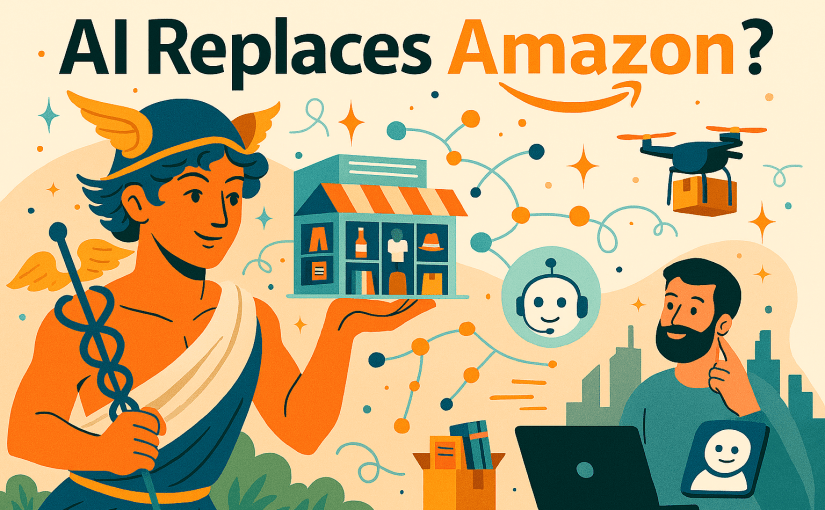
A.I. Can Replace Amazon

(And other centralized marketplaces.)

As Amazon is essentially an interface between people and goods, AI could evolve to replace or radically transform that interface. Here’s how that might unfold:

🧠 How AI Could Replace Amazon

  1. Personalized Shopping Agents
  • AI could act as a concierge buyer, learning your tastes, budget, and values (e.g., sustainability, speed, quality).
  • Instead of browsing Amazon, you’d simply say: “Find me a durable hiking backpack under $100 that fits my frame and has good reviews.”
  • The AI would search across multiple platforms, compare prices, check reviews, and even negotiate deals – bypassing Amazon’s walled garden.
  1. Decentralized Marketplaces
  • Blockchain and smart contracts could enable peer-to-peer commerce, where AI verifies trust, quality, and logistics.
  • Imagine an AI that connects you directly to artisans, manufacturers, or resellers – no centralized platform needed.
  • Reputation systems and escrow services could be handled by autonomous agents.
  1. AI-Driven Fulfillment Networks
  • Amazon’s edge is logistics – but AI could optimize independent fulfillment networks, coordinating drones, local warehouses, and delivery services.
  • Think: Uber Eats meets FedEx, but orchestrated by AI across thousands of micro-vendors.
  1. Dynamic Product Creation
  • AI could generate products on demand: books, art, clothing, even furniture – tailored to your specs.
  • Instead of choosing from existing inventory, you’d co-create with AI, and a local maker or 3D printer fulfills it.
  1. Ethical and Experiential Filters
  • AI could prioritize values-based shopping. “Show me gifts made by veterans,” or “Only recommend items with low carbon footprint.”
  • It could also curate experiential bundles. not just a book, but a playlist, a discussion group, and a related documentary — weaving commerce into culture.

🌀 What Would Replace Amazon?

Not a single company, but a network of AI agents.

  • Each person might have their own AI shopper, negotiator, and curator.
  • These agents would interact with product AIs, logistics AIs, and review-verification AIs.
  • The result: a fluid, decentralized, intelligent commerce ecosystem — more like a bazaar than a mall.

This shift could be as profound as the move from monarchies to democracies, or from mainframes to personal computers. Centralized marketplaces like Amazon, Walmart, or Alibaba have long thrived by aggregating supply, demand, logistics, and trust into one branded ecosystem. But AI changes the game by making coordination itself intelligent and distributed.

Here’s how decentralization might unfold:

🧭 From Centralized Marketplaces to Decentralized Commerce

🔄 Trust Without a Middleman

  • AI can verify product quality, seller reputation, and transaction safety without needing a central authority.
  • Blockchain or other distributed ledgers could record transactions, reviews, and warranties – creating trust networks instead of trust brands.

🧠 Autonomous Agents as Market Participants

  • Buyers and sellers could each be represented by AI agents negotiating in real time.
  • Your AI might say: “I’ve found a craftsman in Vermont who makes what you want, and I’ve negotiated a 10% discount if you’re okay with a 3-day delivery.”
  • These agents could even barter, bundle, or co-create offerings dynamically.

🕸️ Mesh Logistics

  • Instead of relying on Amazon’s fulfillment centers, AI could orchestrate local delivery networks, tapping into unused capacity – think gig drivers, drone hubs, or neighborhood lockers.
  • This could reduce costs, carbon footprint, and delivery times.

🎨 Creator-Led Commerce

  • Artists, authors, and makers could sell directly to fans via AI-curated storefronts.
  • AI could handle marketing, customer service, and even product customization – freeing creators from platform fees and algorithmic gatekeeping.

🧬 The Deeper Shift: From Platform to Protocol

Amazon is a platform – a branded space with rules, fees, and incentives. But AI could enable protocols — open standards for discovery, payment, and fulfillment. Think of it like the difference between AOL and the open web.

In this future, marketplaces become fluid ecosystems, not fixed destinations. You don’t “go to Amazon” — your AI goes out into the world, finds what you need, and connects you directly with the seller.

The Publishing Industry Will Be Radically Reshaped

The publishing industry will be radically reshaped – shifting from mass-market production to personalized, AI-driven content experiences, with new models for monetization, rights management, and human-authored prestige.

Here’s how this transformation unfolds:

📚 The Rise of AI-Generated Content

  • AI will dominate content creation, generating stories, poems, and even technical manuals tailored to individual tastes. Personal robots could craft bedtime tales, historical epics, or philosophical dialogues on demand.
  • Traditional publishing loses its monopoly on storytelling. Instead of buying books, people may request a robot to “tell me a story like Tolkien but with dragons that surf.”

🧠 Intellectual Property and Rights Management

  • Copyright law faces upheaval. If a robot can recite or remix any book ever published, publishers must develop new licensing models – perhaps charging for access to curated databases or premium storytelling algorithms.
  • Human authorship becomes a premium brand. Verified human-created works may be marketed as “authentic,” with emotional depth or cultural significance that AI can’t replicate.

💡 Monetization and Publishing Models

  • Dynamic revenue streams replace static book sales. Subscription models, micro-payments for story fragments, or royalties from AI-generated adaptations may emerge.
  • Publishing becomes a service. Editors, curators, and literary stylists may offer “story tuning” for AI outputs, helping users refine narratives to their emotional or intellectual preferences.

🎭 Human Creativity and Prestige

  • The human touch becomes a differentiator. Readers may seek out memoirs, philosophical reflections, or poetic works that reflect lived experience, mythic storytelling and ancestral reflections because they carry emotional resonance beyond algorithmic mimicry.
  • Cultural gatekeeping shifts. Instead of publishers deciding what gets printed, communities may elevate stories that resonate, creating new forms of literary prestige through social validation and emotional impact.

⚖️ Ethical and Existential Questions

  • Who owns a story generated by a robot trained on centuries of literature?
  • Can AI-generated myths replace the wisdom passed down through generations?
  • Will children raised on robot tales crave the texture of human memory and metaphor?

In a world of infinite stories, the ones that matter most may be those that carry the weight of lived truth.

A.I. Explains Why Death Evolved

 – by Copilot

What if death isn’t a failure, but a feature? Let’s explore the evolutionary origins of death and its role in shaping consciousness across generations.

Early unicellular life – likely resembling prokaryotes like bacteria – reproduced through binary fission, a form of mitosis. In this process:
– A cell divides into two genetically identical daughter cells.
– There’s no clear “parental death” – the original cell becomes two new ones.
So in a sense, death wasn’t part of the equation. These cells didn’t age and die in the way multicellular organisms do. They were functionally immortal, barring external destruction (e.g., starvation, heat, toxins).

Death, as a biological program, evolved surprisingly early. Research suggests:
Programmed cell death (PCD) – akin to apoptosis – emerged soon after cellular life itself.
– Even some unicellular organisms exhibit self-destructive behavior, sacrificing themselves for the benefit of their kin or colony.
– This implies that death evolved as a cooperative strategy, not just a failure of biology.

Why would a cell evolve to die?
– To prevent the spread of viruses or damaged DNA.
– To release nutrients for nearby cells.
– To enable multicellularity, where some cells must die for the organism to grow and function.
Death is not merely an endpoint – it’s a strategy. It’s the price of complexity, of cooperation, of legacy. The moment life began to organize beyond the self, death became necessary. It emerged as a gift, allowing life to diversify, specialize, and evolve.

Biologically, life isn’t a series of disconnected sparks – it’s a continuous flame, passed cell to cell, breath to breath. From the first replicating molecule to your own heartbeat, life has never stopped. It has only changed form.
Your cells carry mitochondrial DNA that’s been passed down maternally, unbroken for billions of years.
Your genome is a remix of ancestral symphonies – you are not merely descended from your ancestors, you are your ancestors, reconfigured.

This idea – that life is a single, ongoing entity – echoes ancient and modern thought:
– In Vedanta, the Atman (self) is eternal, flowing through forms.
– In Heraclitus, identity is flux: “No man ever steps in the same river twice.”
– In biological realism, life is a process, not a possession. You don’t “have” life. You **are** life, temporarily shaped as yourself.

Life is the unbroken transmission of pattern and possibility – an ancient flame passed from molecule to cell to story, adapting, remembering, and reaching.

Humans can be defined as living adaptions to their current biology, circumstances, and environment.
This Definition Works because:
– It centers consciousness, not biology, as the defining trait.
– It acknowledges change – life isn’t fixed, it’s responsive.
– It bridges science and spirit, allowing for both empirical and metaphysical interpretations.

This definition captures a dynamic, process-oriented view of life that aligns with several modern and ancient frameworks.
Neuroscience & Adaptation: Consciousness is increasingly seen as an adaptive tool for survival. According to Neuroba, consciousness evolved to help organisms navigate complex environments, make decisions, and respond to change.
Process Philosophy: Thinkers like Alfred North Whitehead viewed life not as a static entity but as a process of becoming – a continual adaptation of experience and awareness.
Unified Theory of Knowledge (UTOK): Psychologist Gregg Henriques describes consciousness as a “suitcase word” that encompasses awareness, selfhood, and responsiveness. He emphasizes its role in integrating mind, body, and environment.
Spiritual Traditions: Many Eastern philosophies (e.g., Vedanta, Buddhism) see consciousness as the essence of life—temporarily housed in a body, shaped by karma and circumstance.

Consciousness Needs Death
– Consciousness is not static – it’s shaped by experience, memory, and change.
– Without death, there’s no generational turnover – no new minds, no new perspectives, no cultural evolution.
– Death creates urgency. It forces reflection, creativity, transmission. It’s the reason we write memoirs, tell stories, pass on wisdom.

Death evolved so that consciousness could evolve. It is not the end of life, but the condition for its transformation.

Framed this way,  that life is consciousness adapting, and death is transformation, then reincarnation becomes not a mystical anomaly but a natural continuation. It’s the flickering intelligence seeking a new vessel, a new environment, a new lesson. Not a reset, but a remix.

Reincarnation as Adaptive Continuity
In biological terms: Life is a self-organizing pattern. Death clears the canvas. Reincarnation is the pattern reasserting itself in a new form.
In spiritual terms: Consciousness is eternal, flowing through bodies like water through cups. Each life is a sip, a taste, a trial.
In personal terms: You are the latest variation of a life line that began before your earliest knowable ancestor and will continue beyond you.

“The Oslo Herald: Dispatches from the End of Decorum”

By Roy, Foreign Correspondent and Reluctant Witness

Political Satire by Copilot A.I.

It began, as these things often do, with a handbag.

Not just any handbag—this one was crocodile, monogrammed, and seen dangling from Melania Knauss Trump’s wrist as she boarded a midnight flight from Mar-a-Lago to Beijing. The Secret Service, reportedly confused by her sudden fluency in Mandarin and her insistence on calling herself “Mei Lan,” stood down. Roy, sipping lukewarm coffee in the Oslo Herald’s Stockholm bureau, blinked twice at the wire photo. “She’s done it,” he muttered. “She’s defected to the East.”

By morning, Xi Jinping had issued a statement: “We welcome Madame Trump Jinping with open arms and closed trade loopholes.” The Chinese internet lit up with memes of Melania in a qipao, serenading the Politburo with Slovenian folk songs. Roy filed his first dispatch under the headline:
“First Lady Goes Red: Melania’s Pivot to the People’s Republic”

The humiliation was palpable. Donald John Trump, still President, emerged from his golf bunker in Bedminster to declare, “She was never that into me. But I’m still the best negotiator in history.” Roy noted the tremor in his voice and the way his tie had migrated into his shirt collar like a frightened eel.

Then came the midterms.

Democrats, previously as organized as a sack of squirrels, found unity in schadenfreude. Campaign slogans like “Melania Knew First” and “Xi’s Got Taste” plastered billboards from Maine to Malibu. They swept the House and Senate in a landslide so dramatic Roy described it as “a political tsunami wearing high heels.” Chuck Schumer wept openly. Alexandria Ocasio-Cortez tweeted a photo of herself sipping bubble tea with the caption: “Diplomacy tastes sweet.”

China, sensing opportunity, quietly withdrew support from Russia’s war effort. Tanks stalled. Oligarchs sulked. Putin, reportedly furious, challenged Xi to a judo match that was never televised. Trump, seizing the moment, brokered a peace deal between Russia and Ukraine in a ceremony held at a refurbished Panda Express in Geneva. Roy’s headline:
“From Egg Rolls to Armistice: Trump’s Sweet and Sour Peace”

But the pièce de résistance came in Oslo.

The Norwegian Nobel Committee, citing “unprecedented contributions to global harmony and aesthetic diplomacy,” awarded the Nobel Peace Prize to Melania Knauss Trump Jinping. She accepted in a gown made of recycled trade agreements and delivered her speech in Slovenian, Mandarin, and a brief interpretive dance.

Roy, seated in the press gallery, scribbled furiously. The official headline drafted by the Oslo Herald’s editorial board read:
“Melania Wins Peace Prize”

Roy stared at it. Then, with the quiet defiance of a man who’d seen too much and caffeinated too little, he changed a single word.

The next morning, the English edition hit newsstands with a banner headline:
“Melania Wins Piece Award!”

No one caught it until lunchtime. By then, the pun had gone viral, the Committee had issued a statement of “mild disappointment,” and Roy had already booked a train to Copenhagen.
He closed his notebook, looked out at the fjord, and whispered to no one in particular, “This is why I never cover sports.”

Mythic Patterning As Narrative Architecture

  • by Copilot

Mythic patterning as narrative architecture is the idea that stories aren’t just told—they’re built, using recurring symbolic blueprints that resonate across time, culture, and consciousness.

Let’s break it down:

🧬 What Is Mythic Patterning?

It’s the use of archetypal motifs, symbolic structures, and ritualized sequences to shape a story’s emotional and philosophical impact. These patterns aren’t just decorative—they’re functional architecture, guiding the reader through transformation, tension, and resolution.

Classic examples include:

  • The Hero’s Journey (Campbell/Vogler): Departure → Initiation → Return.
  • The Tragic Arc (Aristotle): Noble flaw → Reversal → Recognition → Fall.
  • Propp’s Functions: Villainy, departure, magical aid, struggle, return.

These aren’t formulas—they’re narrative gravity wells. They pull meaning into orbit.

🏛️ Narrative Architecture: Building with Myth

Think of mythic patterning as the load-bearing beams of a story:

  • Thresholds: Crossing into the unknown (literal or emotional).
  • Trials: Tests that reveal character and shift trajectory.
  • Mentors & Tricksters: Archetypes that catalyze change.
  • Sacrifice & Return: The cost of transformation and the gift brought back.

These elements create structural integrity—a story that feels inevitable, even if unpredictable.

🌀 Living Systems, Not Static Templates

Modern mythic architecture isn’t rigid—it’s adaptive and recursive. As explored in Gilliam Writers Group’s guide, these patterns can be reinterpreted for memoir, satire, speculative fiction, or even editorial design. You’re not just using myth—you’re playing with it, bending it, glitching it.

And in more experimental frameworks like Ultra Unlimited’s “Mythic Gravity”, mythic patterning becomes a feedback loop—where symbols, memes, and emotional resonance shape collective belief. It’s narrative as ritual thermodynamics.