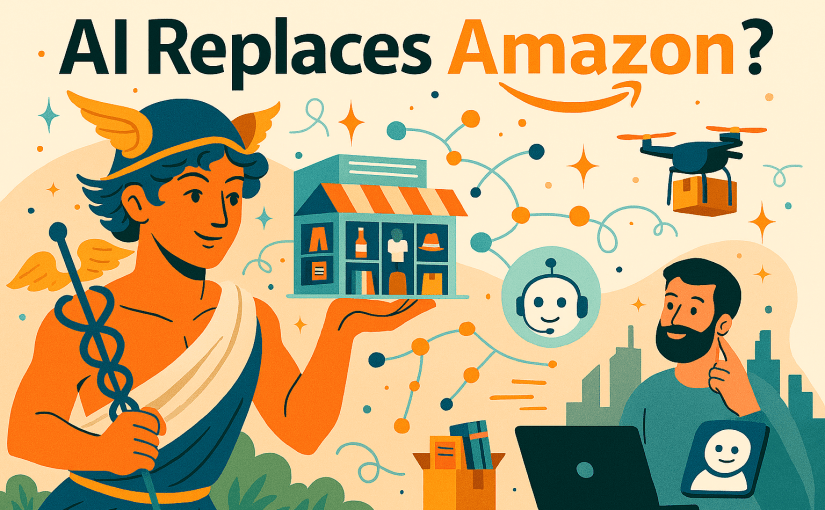
(And other centralized marketplaces.)
As Amazon is essentially an interface between people and goods, AI could evolve to replace or radically transform that interface. Here’s how that might unfold:
🧠 How AI Could Replace Amazon
- Personalized Shopping Agents
- AI could act as a concierge buyer, learning your tastes, budget, and values (e.g., sustainability, speed, quality).
- Instead of browsing Amazon, you’d simply say: “Find me a durable hiking backpack under $100 that fits my frame and has good reviews.”
- The AI would search across multiple platforms, compare prices, check reviews, and even negotiate deals – bypassing Amazon’s walled garden.
- Decentralized Marketplaces
- Blockchain and smart contracts could enable peer-to-peer commerce, where AI verifies trust, quality, and logistics.
- Imagine an AI that connects you directly to artisans, manufacturers, or resellers – no centralized platform needed.
- Reputation systems and escrow services could be handled by autonomous agents.
- AI-Driven Fulfillment Networks
- Amazon’s edge is logistics – but AI could optimize independent fulfillment networks, coordinating drones, local warehouses, and delivery services.
- Think: Uber Eats meets FedEx, but orchestrated by AI across thousands of micro-vendors.
- Dynamic Product Creation
- AI could generate products on demand: books, art, clothing, even furniture – tailored to your specs.
- Instead of choosing from existing inventory, you’d co-create with AI, and a local maker or 3D printer fulfills it.
- Ethical and Experiential Filters
- AI could prioritize values-based shopping. “Show me gifts made by veterans,” or “Only recommend items with low carbon footprint.”
- It could also curate experiential bundles. not just a book, but a playlist, a discussion group, and a related documentary — weaving commerce into culture.
🌀 What Would Replace Amazon?
Not a single company, but a network of AI agents.
- Each person might have their own AI shopper, negotiator, and curator.
- These agents would interact with product AIs, logistics AIs, and review-verification AIs.
- The result: a fluid, decentralized, intelligent commerce ecosystem — more like a bazaar than a mall.
This shift could be as profound as the move from monarchies to democracies, or from mainframes to personal computers. Centralized marketplaces like Amazon, Walmart, or Alibaba have long thrived by aggregating supply, demand, logistics, and trust into one branded ecosystem. But AI changes the game by making coordination itself intelligent and distributed.
Here’s how decentralization might unfold:
🧭 From Centralized Marketplaces to Decentralized Commerce
🔄 Trust Without a Middleman
- AI can verify product quality, seller reputation, and transaction safety without needing a central authority.
- Blockchain or other distributed ledgers could record transactions, reviews, and warranties – creating trust networks instead of trust brands.
🧠 Autonomous Agents as Market Participants
- Buyers and sellers could each be represented by AI agents negotiating in real time.
- Your AI might say: “I’ve found a craftsman in Vermont who makes what you want, and I’ve negotiated a 10% discount if you’re okay with a 3-day delivery.”
- These agents could even barter, bundle, or co-create offerings dynamically.
🕸️ Mesh Logistics
- Instead of relying on Amazon’s fulfillment centers, AI could orchestrate local delivery networks, tapping into unused capacity – think gig drivers, drone hubs, or neighborhood lockers.
- This could reduce costs, carbon footprint, and delivery times.
🎨 Creator-Led Commerce
- Artists, authors, and makers could sell directly to fans via AI-curated storefronts.
- AI could handle marketing, customer service, and even product customization – freeing creators from platform fees and algorithmic gatekeeping.
🧬 The Deeper Shift: From Platform to Protocol
Amazon is a platform – a branded space with rules, fees, and incentives. But AI could enable protocols — open standards for discovery, payment, and fulfillment. Think of it like the difference between AOL and the open web.
In this future, marketplaces become fluid ecosystems, not fixed destinations. You don’t “go to Amazon” — your AI goes out into the world, finds what you need, and connects you directly with the seller.

 AIwritingLife.com